Research & Projects
PhD Research Overview
My PhD thesis at MIT was titled “Coordination of Distributed Energy Resources (DERs) for a reliable, resilient, and affordable decarbonized grid. For this work, I was also awarded the Aarav Amar Bajpayee Memorial Prize for Graduate Student Societal Impact by the MIT Department of Mechanical Engineering, recognizing my research related to the health of the planet & global energy sustainability.
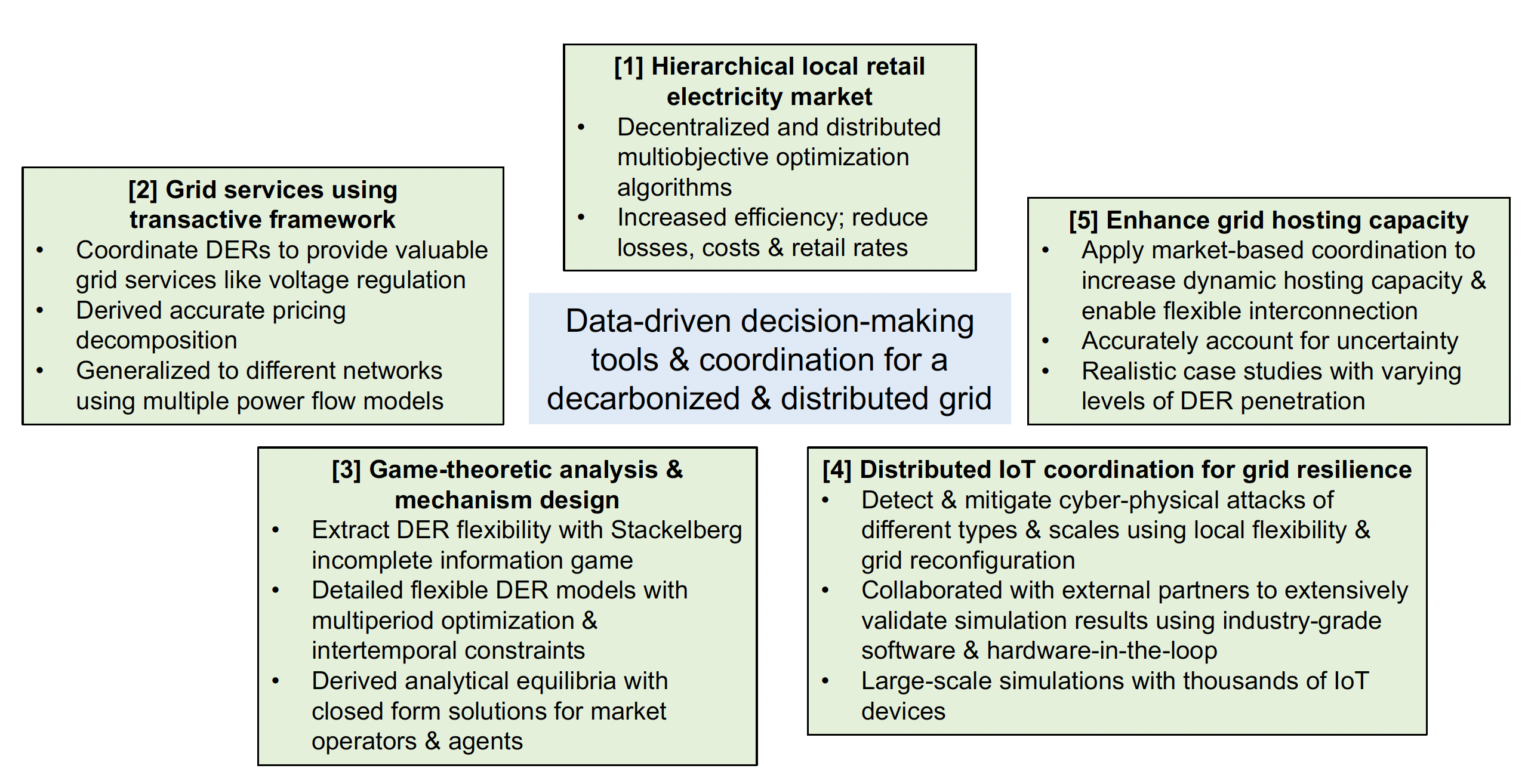
In my PhD, I applied various tools, including distributed & decentralized optimization, game theory, market design & machine learning, to solve challenging planning & operational problems for the future power grid rich in renewables, battery storage & flexible demand (electric vehicles, heat pumps, data centers). I showed that coordinating flexible DERs can significantly lower network costs, losses & consumer electricity prices. I also applied our methods to improve efficiency, hosting capacity, power quality & grid resilience to cyber-physical attacks or outages. You can find my PhD thesis defense slides below:
Beyond my thesis, I got the opportunity to work on side projects related to transmission grid modernization, physics-informed neural networks and neural differential equations, timeseries forecasting & blockchain-based frameworks for energy markets. I also enjoyed supervising & mentoring students on projects related to (i) distributed model predictive voltage control, (ii) accurate valuation of energy storage in markets under uncertainty, and (iii) understanding impacts of socioeconomic factors on the distribution of DERs in the United States. Please also see publications corresponding to these projects.
Current Research Interests
- Physics-informed machine learning (ML): Physics-informed neural networks, neural operators, operator networks, neural differential equations, hybrid physical models, graph neural networks
- Optimization: Convex, non-convex, & mixed-integer problems, particularly for applications in power grids, energy systems, transportation networks, and more. Using ML to accelerate optimization.
- Generative AI for physical applications: Improving the accuracy, reliability, safety, and stability of advanced model architectures (transformers, diffusion models, etc.) for critical engineering applications like grid operation, battery management, robotics, etc.
- Numerical methods: Developing accelerated & more accurate simulation methods for complex, nonlinear, and high-dimensional systems.
- Advanced methods for state estimation, system identification, and control, with a focus on approaches using a combination of classical methods (with guarantees) and data-driven methods.
- Application areas: Power & energy systems, transportation & mobility systems, batteries, industrial process control, smart cities, cyber-physical human-in-the-loop system models, etc.
A few other selected projects
Learning Dynamical Models through Data Science
Here, we compared different data-driven approaches to learn and approximate models of dynamical systems. Specifically, (i) PDE-FIND, which is a method for partial differential equation discovery using sparse regression, and (ii) Dynamic mode decomposition (DMD) based on Koopman operator theory.
Increasing the Accuracy of Intra-day Stock Return Predictions Using Textual Information (Code)
Here, we leveraged additional textual information using natural language processing, in addition to quantitative data. We applied various statistical regression and machine learning methods to improve prediction accuracy.